Monday, August 1, 2011

Peru President Raises Wages, Freshly Sworn

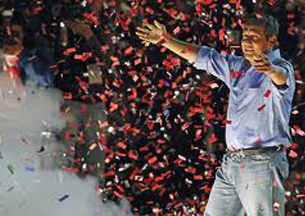
LIMA, Peru  — Ollanta Humala, the leftist military man who won Peru's presidency after abandoning a radical platform, promised in his inaugural address Thursday to make his priority the one in three Peruvians still mired in poverty.
The 49-year-old former army lieutenant colonel charted a plan for spreading the wealth from Peru's mineral boom beyond Lima, where it has been concentrated among a small elite, to long-neglected hinterlands.
"Peru's peasants and the poor in the countryside in general will be the priority," Humala said in remarks before a newly installed Congress and dignitaries who included 11 presidents, almost all from South America.
He quoted South Africa's anti-apartheid hero and former president, Nelson Mandela, in arguing there can be no democracy where misery and "social asymmetry" persist.
Humala's will be a daunting juggling act: He also signaled his intention to maintain the business status quo and honor all international pacts, including a raft of free-trade agreements enacted by his predecessors.
To reassure foreign investors, Humala retained the incumbent central bank chief, Julio Velarde, and named as finance minister Luis Miguel Castilla, a deputy finance minister for the past year and a half in the outgoing government of President Alan Garcia.
The Cabinet is dominated by moderate technocrats but also includes, as culture minister, the renowned singer Susana Baca. She is Peru's first black Cabinet member.
Humala didn't explain how he planned to pay for the generous social programs he catalogued Thursday, most of which he promised during the campaign, though he has said he intends to seek taxes on windfall mining profits.
The pledges include modest old-age pensions for Peruvians at age 65, beginning with the neediest; raising the minimum monthly wage in two stages from $218 to $270 by next year; free preschools in Peru's poorest districts, college scholarships for top-performing needy students and building hospitals in 50 cities where they're lacking. The first minimum wage increase — $27 — is slated for next month.
Humala also promised to invest in public transportation in the traffic-choked capital of Lima; to expand highways and railways; to rebuild Peru's merchant marine and to re-establish a national airline. Aeroperu went bankrupt in 1999.
He said he would dedicate more natural gas from the Camisea field for domestic use rather than export, and has promised to lower natural gas prices, though he did not mention a target price.
Humala won't have an easy time in Congress, where his party has just 47 of 130 seats and will have to depend on lawmakers from the Peru Posible party of former President Alejandro Toledo for a majority.
The main opposition in Congress comes from the Fujimori camp, the second-biggest voting bloc. Humala narrowly defeated Keiko Fujimori, daughter of imprisoned former President Alberto Fujimori, in a June 5 runoff.
The Fujimoristas tried to shout down Humala when, during his swearing-in, he said he was assuming power in the spirit of the 1979 constitution.
That was a snub to the 1993 magna carta passed under the autocratic regime of Alberto Fujimori, who is serving a 25-year prison term for authorizing death squads and corruption. The 1993 constitution specifies a reduced state role in the economy, justifying Fujimori's wave of privatizations of state-owned companies.
Humala got warm greetings from fellow leftist Presidents Evo Morales of Bolivia, Rafael Correa of Ecuador and Cristina Fernandez of Argentina. The United States sent Dan Restrepo, the top Western Hemisphere official in the White House.
The nascent UNASUR union of South American nations met later Thursday and agreed to proposal by President Juan Manuel Santos of Colombia to convene its finance ministers in Argentina, likely on Aug. 10-11, to discuss a possible collective response to the European and U.S. debt crises. The value of some regional currencies against the U.S. dollar and the euro have risen to levels that are hurting exports. Santos said Mexico was invited to participate.

Analysts said Mr. Humala's remarks contained no big surprises. The 49-year-old former military officer started his political career as a populist in the mold of Venezuela's Hugo Chávez. But he moved toward the center this year and pleased financial markets last week by naming U.S.-trained technocrats to major economic posts.

"Mr. Humala's speech contained what was expected, and most importantly didn't include any radical changes, which should be a positive for markets and adds credibility to what he has been saying since the June 5 run-off vote," said Cesar Perez, a managing director with Celfin Capital.

Bulltick Capital Markets had a similar reaction. "In his inauguration speech today, where presidents-elect historically give their vision of how their administration will take shape, Humala maintained the generally market friendly tone," it said.

Mr. Humala reiterated that he would maintain the basic tenets of Peru's economic policy, which has produced 12 consecutive years of growth. He said his government would ensure "healthy economic growth and macroeconomic standards," as well as "respect for the fiscal rules to confront external crises or natural disasters."

He also said he wants Peru's economy to be well integrated with those of its neighbors. "We don't want an autarkic economy that stays within itself, isolated from the process of globalization," he said. "Rather, we want an economy that's integrated—first of all integrated with the region and especially with our Andean and South American neighbors."

Mr. Humala also repeated his view that the country must do more to ensure equitable wealth distribution. To that end, he announced the creation of a new cabinet ministry, "The Ministry of Development and Inclusion."

One moment of controversy in the inauguration came when Mr. Humala said he would abide by the principles of Peru's previous constitution of 1979, not its current one, drawing jeers from supporters of former president Alberto Fujimori. Mr. Fujimori replaced the earlier constitution in 1993 in an act that Mr. Humala contends was illegal since it followed a coup by Mr. Fujimori in which he closed Congress and the courts. The latter constitution, however, was written by a constituent assembly and approved in a referendum.

Mr. Fujimori is now in prison for his role in a massacre that occurred while he was president. Mr. Humala defeated Mr. Fujimori's daughter, Keiko, to win the presidency in June.

Mr. Humala will serve a five-year term succeeding the centrist Alan Garcia. Mr. Garcia boycotted the swearing-in ceremony, saying he feared that members of the new Congress would give him an unfriendly reception.

Mercedes Aráoz

Mercedes Rosalba Aráoz Fernández, Lima, 5 August 1961) is a Peruvian economist, professor, and politician. She served as Minister of Foreign Commerce and Tourism from 2006 to December 2009, after which she was appointed as Peru's Finance Minister.
Aráoz graduated from the University of the Pacific in Lima and the University of Miami.
On Tuesday, November 2, Aráoz agreed to be the Presidential Candidate of the Peruvian Aprista Party ( American Popular Revolutionary Alliance ) for the Presidential Elections that will take place on April 10, 2011.
Permanent short link for Go Daddy.com Just ez2.me
Spring Savings! $7.99 .com
Next time for Go Daddy: Easy to you just www.ez2.me Dadicated link for Go Daddy.com Just ez2.me

Ministry of Foreign Commerce and Tourism Peru

Ministry of Foreign Commerce and Tourism of Peru or MINCETUR is the ministry in charge of issues pertaining to foreign commerce of the Government of Peru and the promotion of Tourism in Peru. The current Minister of Foreign Commerce and Tourism is Mercedes Aráoz.

Objectives
The Ministry of Foreign Commerce and Tourism defines, directs, executes, coordinates, and supervises the policies of foreign commerce and tourism. It has responsibility in issues pertaining to exportation and international business agreements, which is manages in coordination with the Ministry of Foreign Relations, and the Ministry of the Economy and Finances as well as other sectors of the Peruvian government within their respective jurisdictions.
Additionally it is in charge of regulating foreign commerce. The ministry directs international trade negotiations for the Peruvian government and is empowered to sign agreements within its jurisdiction. In the Tourism sector, it promotes, orients, and regulates touristical activity with the goal of promoting sustainable development for tourism, and it includes the promotion, orientation, and regulation of arts and crafts directed towards tourists.

Accomplishments
It promotes free trade agreements, as well as manages the tourism entity PromPeru, a government organization responsible for promoting Tourism to Peru around the world. The ministry has signed the following treaties:
Canada-Peru Free Trade Agreement
Chile-Peru Free Trade Agreement
Thailand-Peru Free Trade Agreement

Korea-Peru FTA Goes Into Effect On Monday

Free trade agreement between Korea and Peru goes into effect today.

Peru is the second Latin American nation (after Chile) and the seventh world economy to implement an FTA with Korea.

The agreement, signed in March, is expected to benefit Korea, as Peru’s average tariffs, at 11 percent, were relatively high. Korea’s automobiles, electronics and pharmaceutical exports are expected to benefit the most.

Peru has had an average annual economic growth of 7.2 percent in the past five years, and its abundant resources have made it the Latin American nation with the fastest inflow of foreign investment.

All tariffs will be eliminated within a decade. Until then, Korea will immediately eliminate tariffs on 10,044 items, including major minerals, tires, coffee, sugar and bicycles, which are 86.8 percent of all items in the agreement.

Peru will immediately eliminate tariffs for 5,001 Korean products, including televisions, automobile parts, tires and large vehicles, which account for 68.6 percent of the total amount of products agreed upon.

Rice, which was a sensitive issue on the Korean side, was not included in the pact.

In order for Korean products to receive tariff-free benefits, they will need to receive country of origin approval. One hundred products made in the Kaesong Industrial Complex, such as clocks and home appliances, are considered Korean products under the agreement.

“Peru is a promising new market, with imports growing at 19.1 percent per year and Korean exports to Peru increasing 27.3 percent per year,” said Myung Jin-ho, a senior researcher at the Korea International Trade Association’s Institute for International Trade. “Peru has become the second largest destination for Korean investment in South America after Brazil, and it has seen annual growth of 23.5 percent in foreign investment.”

Peru has a population of 29.2 million and a per capita income of $5,172 as of 2010, according to the Korean Ministry of Foreign Affairs and Trade.

The deal is expected to create opportunities for Korean investment in mines. Peru has major mineral reserves, with 23.5 percent of the world’s silver, 14.3 percent of its copper and 9.2 percent of its zinc. Apart from its abundance of minerals, Peru is also aggressively improving its infrastructure, including its airport, ports, power plants and tourism sights, creating opportunities for Korea’s builders.

The deal was signed in March this year and approved by Korea's parliament last month.
The agreement calls for all tariffs to be eliminated within the next ten years.
Korea will immediately eliminate tariffs on more than 10-thousand items, including major minerals, tires, coffee, sugar and bicycles, which account for nearly 87-percent of all items in the pact.
Peru will immediately scrap tariffs on about 5-thousand Korean products, including TVs, automobile parts, tires and large vehicles, which make up nearly 69-percent of the total amount of products.
Peru becomes the second Latin American nation after Chile and the seventh economy to implement an FTA with Korea.

Peru finally hit the mark in second round – 2011 FIVB Women’s Junior World Championship

LIMA, Peru - University of Oregon sophomore Lauren Plum and the U.S. National Junior Team ended its run in the FIVB Volleyball Women's Junior World Championships by matching its best-ever finish in Sunday's finale.

The U.S. squad lost to China by a 20-25, 25-19, 25-16, 25-23 score to finish fourth overall and end with a 4-4 record in the tourney.

The Americans hit .324 as a team, and outside hitter Haley Eckerman led the squad in kills (14) and points (18). On defense, Eckerman also led in blocks (2), and the tourney's top libero Natalie Haggalund came up with 10 digs.

Plum ended with six assists and fellow setter Hannah Allison added 18 in the category.

Later in the day, Italy beat top-ranked Brazil by a 21-25, 25-13, 25-20, 25-22 score for the gold medal.

The 18 points contributed by Grecia Herrada of Peru were quite valuable in the teams win. The skipper of the Peruvian team Clarivett Yllescas, Vivian Baella, and Brenda Uribe were also vital to the team’s success. They registered 14 points apiece. Haley Eckerman of the oppossing team was named top-scorer of the match as she clipped 24 points for the U.S. Likewise, Carly Wopat and Madelyn Hustson added 19 and 16 points, respectively.

The uproar of fans and happy slogans encouraged the home team to take a good start in the game. The better attack and defence strategies in the opening set enabled the Peruvian squad to enjoy dominance over their opponents. American team resisted and tried to hinder the march of the hosts but could not hold them back from winning the first set. After dropping the opening set, U.S. team came up with a different plan and levelled the game score by capturing the second set. The see-saw battle continued in the third set and Peru once again extended its lead to 2-1. Americans denied the Peruvian efforts and claimed fourth set to create the dead-lock of 2-2.

It was an equal chance for both teams to make it to the top in the final set of the game. The 15-point golden set was an action pacted affair. The exchange of fast spikes and deadly aces introduced a new rhythem to the clash. The hosts slightly got better and managed to take lead as they closed the final set with a six point lead and announced match victory.

“Congratulations to Peru. They did a very good job and it was a great match. On our side of the net, we failed in the serve and receive and couldn't get into any rhythm. Furthermore, we had problems with the crowd and we let this situation affected us." Said the U.S. captain Kelly Reeves after the match. Her Peruvian counterpart Clarivet Yllescas also added: “I am happy for winning. We knew that it would be hard because we didn’t know very well the rival, but fortunately we could obtain the victory. Congratulations to USA, it was a good match.”

Robert Browning, the U.S. mentor congratulated the winning team and stated that they deserved to win. Speaking of his own team’s performance, he said that they were under immense pressure, committed too many mistakes and eventually had to give in.

Peru's Humala faces critical test to boost economy

LIMA, Peru  — Ollanta Humala, the leftist military man who won Peru's presidency after abandoning a radical platform, promised in his inaugural address Thursday to make his priority the one in three Peruvians still mired in poverty.
The 49-year-old former army lieutenant colonel charted a plan for spreading the wealth from Peru's mineral boom beyond Lima, where it has been concentrated among a small elite, to long-neglected hinterlands.
"Peru's peasants and the poor in the countryside in general will be the priority," Humala said in remarks before a newly installed Congress and dignitaries who included 11 presidents, almost all from South America.
He quoted South Africa's anti-apartheid hero and former president, Nelson Mandela, in arguing there can be no democracy where misery and "social asymmetry" persist.
Humala's will be a daunting juggling act: He also signaled his intention to maintain the business status quo and honor all international pacts, including a raft of free-trade agreements enacted by his predecessors.
To reassure foreign investors, Humala retained the incumbent central bank chief, Julio Velarde, and named as finance minister Luis Miguel Castilla, a deputy finance minister for the past year and a half in the outgoing government of President Alan Garcia.
The Cabinet is dominated by moderate technocrats but also includes, as culture minister, the renowned singer Susana Baca. She is Peru's first black Cabinet member.
Humala didn't explain how he planned to pay for the generous social programs he catalogued Thursday, most of which he promised during the campaign, though he has said he intends to seek taxes on windfall mining profits.
The pledges include modest old-age pensions for Peruvians at age 65, beginning with the neediest; raising the minimum monthly wage in two stages from $218 to $270 by next year; free preschools in Peru's poorest districts, college scholarships for top-performing needy students and building hospitals in 50 cities where they're lacking. The first minimum wage increase — $27 — is slated for next month.
Humala also promised to invest in public transportation in the traffic-choked capital of Lima; to expand highways and railways; to rebuild Peru's merchant marine and to re-establish a national airline. Aeroperu went bankrupt in 1999.
He said he would dedicate more natural gas from the Camisea field for domestic use rather than export, and has promised to lower natural gas prices, though he did not mention a target price.
Humala won't have an easy time in Congress, where his party has just 47 of 130 seats and will have to depend on lawmakers from the Peru Posible party of former President Alejandro Toledo for a majority.
The main opposition in Congress comes from the Fujimori camp, the second-biggest voting bloc. Humala narrowly defeated Keiko Fujimori, daughter of imprisoned former President Alberto Fujimori, in a June 5 runoff.
The Fujimoristas tried to shout down Humala when, during his swearing-in, he said he was assuming power in the spirit of the 1979 constitution.
That was a snub to the 1993 magna carta passed under the autocratic regime of Alberto Fujimori, who is serving a 25-year prison term for authorizing death squads and corruption. The 1993 constitution specifies a reduced state role in the economy, justifying Fujimori's wave of privatizations of state-owned companies.
Humala got warm greetings from fellow leftist Presidents Evo Morales of Bolivia, Rafael Correa of Ecuador and Cristina Fernandez of Argentina. The United States sent Dan Restrepo, the top Western Hemisphere official in the White House.
The nascent UNASUR union of South American nations met later Thursday and agreed to proposal by President Juan Manuel Santos of Colombia to convene its finance ministers in Argentina, likely on Aug. 10-11, to discuss a possible collective response to the European and U.S. debt crises. The value of some regional currencies against the U.S. dollar and the euro have risen to levels that are hurting exports. Santos said Mexico was invited to participate.
Venezuelan President Hugo Chavez, who closely supported Humala in his failed presidential bid in 2006, did not make the trip to Lima. He is recuperating from chemotherapy after having a cancerous tumor removed last month. Chavez sent his congratulations in a Tweet from Caracas.
Several hundred supporters cheered Humala as he arrived at the presidential palace, shouting "Viva Humala" and "Yes, he could." But some in the crowd expressed disillusion.
Juan Ruedas, the 49-year-old owner of a small clothing store, expressed concern Humala won't work for most Peruvians because he has now surrounded himself with traditional politicians who Ruedas considers corrupt.
"The right has already corralled Humala," Ruedas lamented.
Alan Garcia, who narrowly defeated Humala in the 2006 race, broke with tradition and opted not to attend the inauguration. He quit the presidential palace more than an hour before his successor's swearing-in, getting into a black SUV with tinted windows and departing without any applause from onlookers.

Humala has made it clear during his election campaign that he plans to follow a moderate centrist path with strict economic discipline like Brazil's popular former president Luiz Inacio Lula da Silva.

Much is at stake for Peru and "time will tell if the new president can continue to grow Peru's economy while also providing for 'a social face'," Ponce said.

A few days after his victory in the June 5 presidential election, Humala set out on a travel agenda to visit most of the continent's leaders and top U.S. policymakers to strengthen ties. He also had an unscheduled meeting with U.S. President Barack Obama.

Humala's tour was seen to have accomplished important diplomatic progress, despite a lack of significant policy discussions, said political analysts with the Council on Hemispheric Affairs (COHA), a Washington-based non-profit research organization.

Broad international cooperation was the best way to remove skepticism about the new president, said Jorge Dominguez, a renowned scholar and chairman of the Harvard Academy for International and Area Studies, adding that democratic policies were easier to build within a supportive international community.

The country's poverty rate was reduced to about 34 percent during Alan Garcia's presidency from 2006 to 2011. This lifted some three million people out of poverty. But about 10 million Peruvians are still living on less than one to two dollars per day, official figures indicate.

"This is about how to deal with the deteriorating effect on living conditions of the people and the rise in inequality and poverty," Humala said, adding: "We are going to build a cabinet of national reconciliation, national unity, in order to provide economic stability for the country."

Humala's new development plan for Peru calls for a transformation through a "National Market Economy", which will focus on expanding domestic markets in order to promote industrialization, strengthening social policies, nationalizing "strategic activities" and modernizing the agricultural and production sectors.

The plan seeks to maintain an economy open to foreign investment and trade, but at the same time build a national economy that creates viable alternatives to ensure rural areas will be developed through a strong local market with dignified jobs and competitive national companies.

"Humala has a historic opportunity now to implement the social policies that Peru has long needed and for which it finally has the economic resources," Dominguez said.